

Does Forgiveness Need To Be Earned?
On Ted Lasso, complex characters, and whether explanations should be excuses.

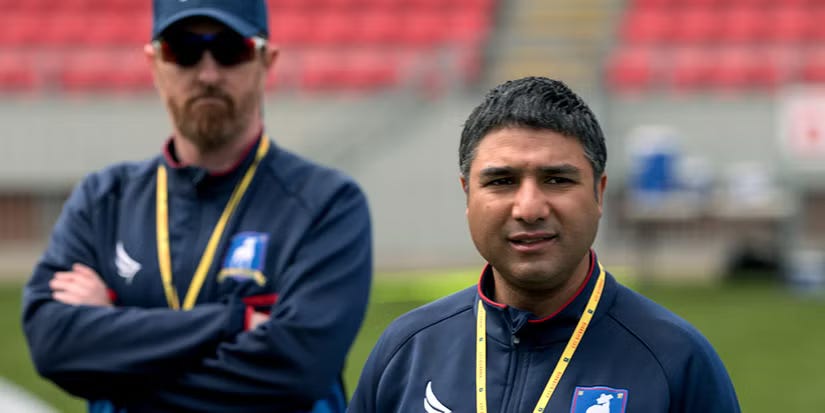
It’s time to believe again, my friends. Ted Lasso is returning to our screens for a fourth season on Wednesday 5 August 2026 and I cannot even begin to express how excited I am. Ted Lasso is one of my favourite shows. I recommend it to absolutely everyone and I have yet to receive any review other than “what a great show”.
Summing up my feeling for this show is hard, so allow me to borrow the words from myself from June 2023 when Season Three, and what we thought was the end of Ted Lasso aired.
I’m the type of person who becomes deeply emotionally connected to all manner of art, and the context in which I experience it for the first time makes all the difference.
Ted Lasso came into my life, into all of our lives, at exactly the right time. I was drowning emotionally at the height of the pandemic. I was terrified of the world I had brought children into. I was extremely triggered by my experience of being fearful of waking up sick when my Mum was immunocompromised. The health anxiety which had been bubbling away under the surface most of my life burst through the surface.
I was a shell of a person.
And then there was Ted. A ray of sunshine in the darkest of storms.
This show made my heart happy. Waiting each week for a new episode gave me a glimmer of hope. It was heartwarming and funny. Emotional and moving. It was, quite simply, everything I needed.
And the context of a show about hope and kindness and believing being birthed into the world during arguably the worst of times is a large part of what I believe has made it a show beloved by so many.
I wept most of the finale episode. It was beautifully written and wonderfully acted. I continued weeping, long after the credits finished, because I was so thankful for this show and so sad it had come to an end.
But they’ve made the right decision. They told the story as it needed to be told. And they knew it was the right time to end.
If you haven’t watched Ted Lasso yet, you should. It’s magnificent.
We’re three years later and we’re coming back in TWO. DAYS. with a fourth season focusing on AFC Richmond’s womens league. Not all the usual cast members will be returning. But it’s still Ted Lasso and in this absolute dumpster fire of a world, I’m happy with anything. So I did what half the internet seems to have done and rewatched the series in preparation for this new season.
Note: there will be spoilers for seasons one to three of Ted Lasso from here. If you haven’t watched the series yet and don’t want to know anything, this is your time to click away, no hard feelings.
One thing that surprised me the most in my rewatch was Nate, who was brilliantly played by Nick Mohammed. When I first watched Ted Lasso, I really liked Nate from the beginning so when he goes over to West Ham at the end of season two, I was both shocked and devastated by how his character “turned”. Upon rewatching, the breadcrumbs that lead to Nate’s eventual character arc are there from his very first introduction in the pilot episode where he runs over to Ted and Coach Beard, screaming at them to get off the grass at when they first arrive before realising who they are. The moment he realises they are “above” him and not below, his demeanour shifts.
This becomes a throughline for Nate. Much like English society, there’s a class attitude and where he sits in relation to other characters changes how he interacts with them, especially at the beginning of the series.
I kept watching and was surprised at how all of the signs were there the whole time and I simply didn’t notice the first time. I posted a Thread, not thinking much of it. I’ve had many a “viral” thread, but I can’t always pick what will land and what won’t.
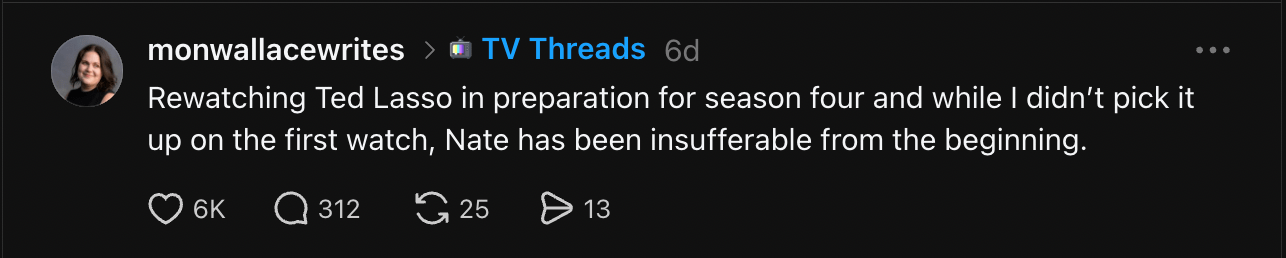
The comments started steadily coming in (that within the first 12 hours, Threads paused notifications on this post, thankfully it started to slow down). It turns out a lot of us have strong feelings about Nate.
Before I get into the discourse, I feel the need to preface that my calling a character “insufferable” doesn’t mean that I think they are unworthy of redemption or kindness or understanding. Throughout the first three seasons, we see a lot of behaviour directed towards Nate from his father to the rest of the team which shows how terribly he is treated.
While I’ve been pondering this very thing, Girl, so confusing feat. Lorde came on during my Spotify shuffle and this line from Lorde’s verse landed perfectly to describe how Nate’s behaviour feels.
“It’s just self defence until you’re building a weapon.”
It’s interesting how much we, myself included, expect people including fictional characters to respond the same way we would to things. We see early on that Nate is treated pretty poorly by the team until Roy sticks up for him and even then, the behaviour we see afterwards is at best indifference. We know hurt people hurt people. But in cases like this, there’s very little analysis around why the players might have treated Nate this way to begin with. Is it due simply to class and rank, that Nate was “below” and so they treated him as such? Did they all have trauma that “excused” their behaviour as well? Where is their understanding?
I have suffered trauma in my life and experienced things that have rewired my brain at a very young age. It’s my responsibility though to make sure that my trauma isn’t being projected onto others.
In the years following my mum’s death, there were some boys at my school who used to make fun of me for crying about it. Yep, I’m not kidding. That actually happened and it was awful. There’s a part of me that will never not be hurt by their behaviour, but as an adult now with a fully developed frontal lobe, there’s an element of forgiveness I’ve been able to achieve. The last thing I would want to do is to turn around and be hurtful towards others going through a particularly rough time. That’s not to say I’m perfect. I was a hard teenager. It wasn’t easy being my friend. I’m saying that now, as an adult, I have an additional layer of responsibility.
To go from being a kit boy to an assistant coach in the space of a conversation is no small feat. But one of my issues with Nate’s character is that he has the approach of “I’ve earned this” and for me he borders the line between earned and deserved. Absolutely Nate’s insight and knowledge of the game made him a natural coach. He’s an excellent coach. For someone sitting on the sidelines for so long, he observed and noted things. But one of the most interesting things about Nate is his inability to recognise that coaching is as much of a team sport as the game itself. He gets upset when Roy joins the coaching team and he’s no longer the only person of interest. He stops celebrating when goals are scored and looks on in disgust when they celebrate together.
He is so certain he is the “wonder kid” that he doesn’t recognise the grace he was given by Ted in being offered the coaching spot and instead of gratefulness, Nate starts building resentment. When it reaches a fever pitch, he berates Ted: “you made me feel like I was the most important person in the world and then you abandoned me”. All while Ted is going through a divorce and having panic attacks. Nate is so absorbed by the wrong being done to him, that he doesn’t stop to consider that Ted wasn’t trying to withhold praise, but that he was merely hanging on.
Over the first two seasons, we watch Nate progressing get meaner, punching down. After all, if that’s how he has been treated, why shouldn’t he?
Forgiveness
Many of the comments on my Thread point to different areas where they noticed the “darkness” in Nate. Many agreed with my point. Many disagreed, arguing that Nate was reacting to a lifetime of bullying (which as I’ve gotten into, I don’t disagree with). So many people felt that the redemption arc and forgiveness at the end of season three wasn’t earned.
Then I saw this comment and I loved it so much.
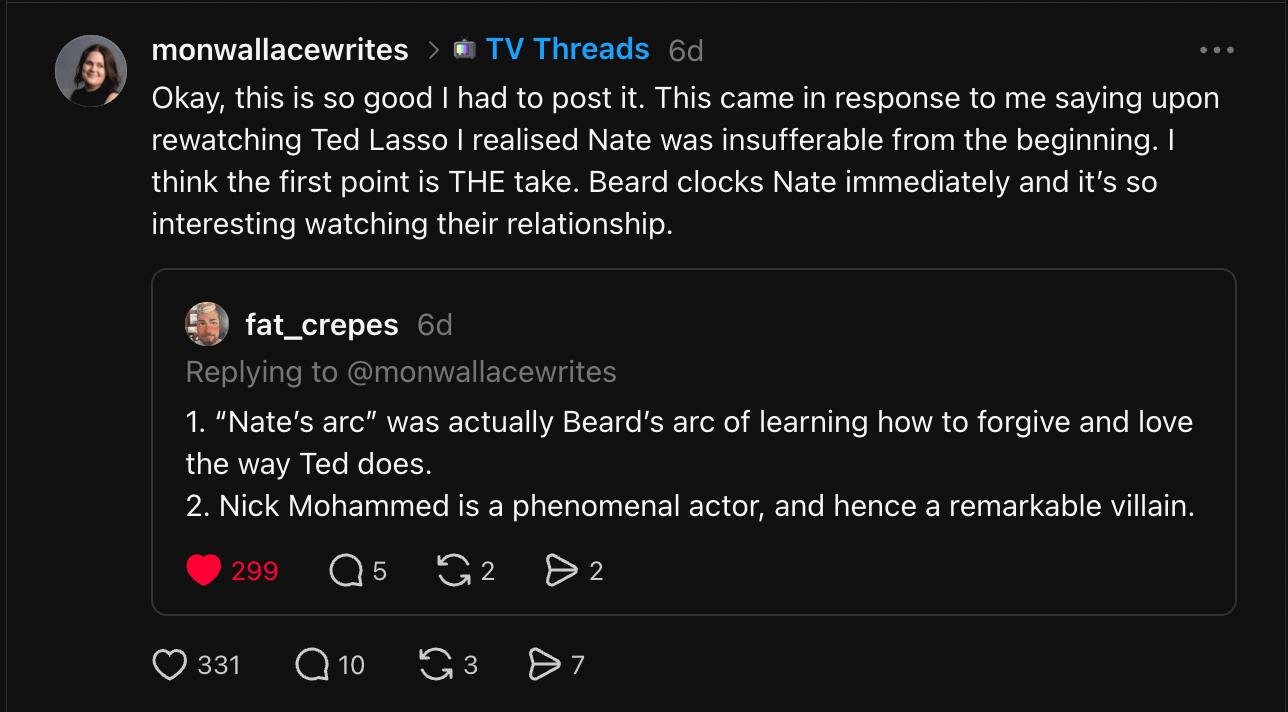
Having rewatched all three seasons in quick succession, I find Nate’s “redemption” earned. It wasn’t immediate. It wasn’t in one moment. It was repeatedly, over many smaller interactions, even while he was still coaching at West Ham. Ted and his son going to the game. Isaac and Colin and Sam coming to the restaurant to ask him to come back. The same Isaac who was awful to him in early season one.
When it’s brought to the coaching team at AFC Richmond to have Nate back on the team, Ted, despite being the most hurt by Nate, has no problem with welcoming him back. It’s Beard who has a reservation which leads Ted to deliver the sentiment of the series:
“I hope that either all of us or none of us are judged by the actions of our weakest moments, but rather by the strength we show when and if we’re ever given a second chance.”
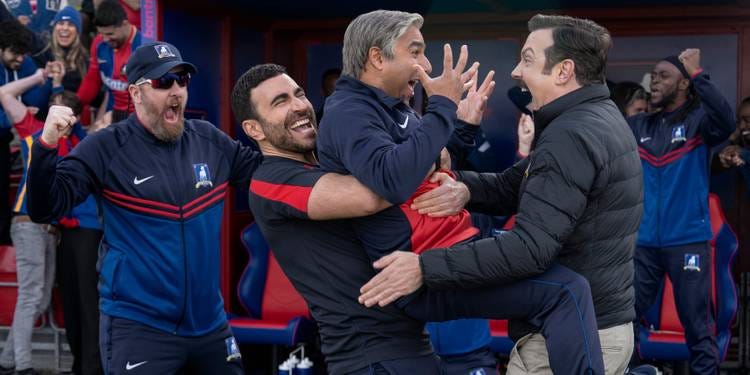
When it comes to forgiveness, we need to stop ourselves from repeating the narrative that forgiveness needs to be earned before it can be given. Forgiveness is so often not about the person in need of forgiveness, but the person doing the forgiving. Beard being able to forgive Nate was a full circle moment for Beard. He transitioned from being the Nate in the situation to being the Ted. Beard was able to recognise the only reason he has the life he has now is from the forgiveness of Ted, and so he extends a hand to Nate.
Nate goes back to being meek, but this time, it feels genuine, like the real him. And it absolutely warmed my heart to watch. He felt the way he did when I watched the series for the first time. I genuinely think I’ll spend the rest of my life trying to figure out how they pulled this off in the writing and the acting that despite the fact the evidence was there, I just willingly ignored it.
The father wound
Another banger of a quote from the series is this one from Ted when talking to Trent Crimm, The Independent: “For me, success is not about the wins and losses. It’s about helping these young fellas be the best versions of themselves on and off the field. And it ain’t always easy, Trent, but neither is growing up without someone believing in you.”
This could be about so many people, especially Nate and Jamie.
I love a complex character and Ted Lasso is filled with them, even Ted himself. My critique of Nate isn’t as a “ughhhhh why is he even in the show” because you need his character for this story. Imagine how boring it would be for there to be zero conflict.
But Nate isn’t the only “villian”.
At the beginning of the series, Jamie Tartt is a harmless villian. Cocky but talented, he focuses on himself as the winner and the prize, at the expense of AFC Richmond. Despite being one of the better players in the league, he doesn’t play football as a team sport and they suffer accordingly.
We see moments with Jamie and his dad and none of them great. After their loss against Manchester City at Wembley, his dad comes into the locker room and shouts at him in front of the whole team, calling him names and belittling him. Jamie ends up throwing a punch, Beard drags his dad away, and Roy crosses the room and envelopes Jamie in a hug.
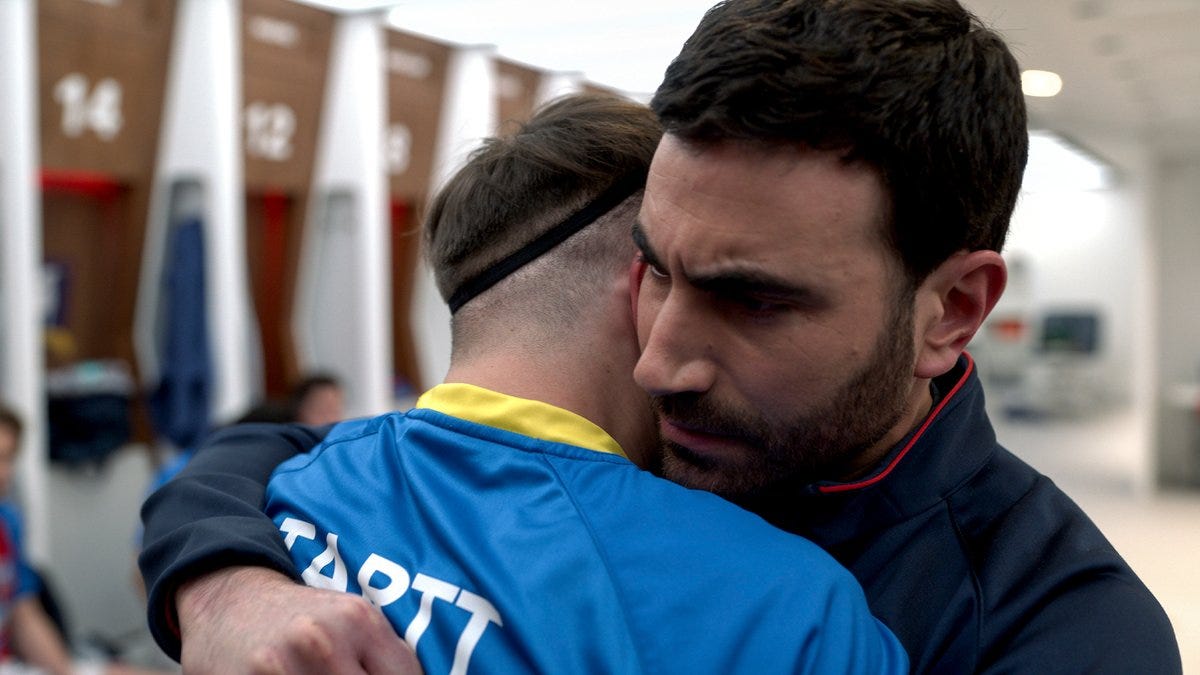
From these interactions, it’s clear Jamie has been on the end of emotional abuse, and likely physical abuse, from his dad his whole life. That the only way he was able to have any kind of connection with him was from his ability to play football.
But we’re more willing to forgive how this explicitly terrible behaviour from a father impacts season one and early season two Jamie than we are to accept that Nate’s dad with his snide comments and lack of belief (despite seeing no hint of raised voices and physical violence) was equally damaging. Nate didn’t have a positive influence in his home from the person he wanted it from the most, his dad.
Ted Lasso is a masterclass in exploring father-son dynamics.
Jamie with his dad.
Nate and his dad.
Higgins both with his sons and talking about his father in talking to Jamie.
Roy mentioning his niece Phoebe’s dad.
The way Ted’s father who he lost to suicide as a teenager shaped his entire attitude. Not quitting anything. The fact he was the one to tell his mum.
Rebecca and her father.
Sam and his dad.
Bill Lawrence absolutely knows how to write father-son relationships, even the non-biological ones. Look at JD and Dr Cox on Scrubs, Jimmy and Paul on Shrinking, and Ted and Nate on Ted Lasso. And how sometimes, no matter how trivial it may seem, you need validation from these father figures in your life, especially when it’s missing from your own dad.
Do you need to earn forgiveness?
I personally don’t think so. In a perfect world, of course it would be lovely for people to realise their wrongs and make amends. But we don’t live in a perfect world and that doesn’t always happen.
The beauty of Ted Lasso is showing that sometimes, you “earn” forgiveness after it’s been given through changed behaviour, kindness, and gratitude. And even though I found Nate “insufferable”, his character arcs was one of my favourites.
With season four of Ted Lasso kicking off in two days, I’d love to know if any of you want me to recap episodes the way I did for The Summer I Turned Pretty? Let me know in the comments!